Freelancer vs Agency vs AI Builder Tools: What You Actually Get in 2026
A definitive, transparent teardown comparing AI website generators, solo freelancers, and specialized digital engineering studios on deliverables, speed, security, and enterprise ROI.
Deconstructing modern digital delivery models: making the right technical investment for your business scale.
Executive Summary & Key Takeaways
AI website builders generate basic brochure prototypes in minutes for under $50, but fail catastrophically on bespoke integrations, SEO dominance, and unique brand differentiation.
Solo freelancers offer cost-effective development, but introduce severe key-person risk, limited multidisciplinary depth, and unpredictable turnaround times.
Specialized engineering agencies deliver end-to-end strategic alignment, bespoke UI/UX, 100/100 Core Web Vitals, and sovereign IP ownership.
Proprietary lock-in from "all-in-one" AI builders prevents code exports, leaving businesses stranded when scaling requirements emerge.
Selecting the correct delivery partner is a function of business maturity: AI builders for validation, freelancers for tactical tasks, agencies for scaling enterprise revenue.
What to Do About This: Action Checklist
1Audit your internal technical capacity and determine whether your team can manage ongoing website maintenance.
2Avoid proprietary platforms that do not provide full Git repository code exports and sovereign hosting rights.
3Require any development partner or agency to provide verifiable Lighthouse performance benchmarks in writing.
4Schedule a consultation with Techsist Labs to build an uncompromising, custom digital presence via /services/website-design/.
The Modern Web Dilemma: AI Tools vs Freelancers vs Agencies
In 2026, business leaders wanting to launch or re-platform a website face a radically transformed vendor landscape. On one extreme, generative AI website builders (Wix Studio AI, Framer AI, Squarespace AI, v0, Relume) promise complete, operational websites in minutes for the cost of a monthly subscription. On the other extreme, established digital agencies charge tens of thousands of dollars for bespoke engineering. In between sits the vast global freelance marketplace on Upwork, Fiverr, and LinkedIn.
With marketing claims becoming increasingly homogenized, founders and executives frequently struggle to understand what they are genuinely paying for. Does an agency build justify a 10x or 20x price premium over an AI generator or a solo contractor?
To answer this objectively, we deconstruct all three pathways across seven critical commercial dimensions: code quality, design differentiation, SEO architecture, scalability, security, operational risk, and total cost of ownership.
1. AI Website Builders: The Prototype Powerhouse with Hard Structural Limits
Generative AI builders have revolutionized early-stage prototyping. By entering a prompt describing your business, these platforms generate complete responsive layouts, generate stock imagery, and draft initial marketing copy in under five minutes for $20 to $60 per month.
Where AI Builders Excel:
- Instant Validation: Testing early startup concepts, event splash pages, or temporary promotions with virtually zero capital outlay.
- Non-Technical Accessibility: Intuitive visual drag-and-drop interfaces that allow non-technical founders to tweak text and colours without writing a line of code.
Where AI Builders Fail Catastrophically:
- Homogenized, Generic Branding: Because AI models are trained on existing web patterns, AI-generated sites look remarkably similar, failing to establish distinct brand authority or premium positioning.
- Inflexible Architecture & Zero Code Sovereignty: Most AI builders operate on closed, proprietary runtimes. You cannot export clean React/Next.js code, self-host on independent cloud providers, or modify backend database logic.
- Shallow Integrations: Connecting complex custom APIs, ERP systems, bespoke booking workflows, or local payment clearing rails (such as PayTo) is fundamentally impossible.
2. Solo Freelancers: Cost-Effective Execution with Key-Person Risk
Hiring a solo freelance developer represents the traditional middle ground. With rates ranging from $50 to $160 per hour, freelancers provide human adaptability and customized code at a fraction of agency overhead.
Where Freelancers Excel:
- Budget Efficiency: Ideal for well-defined, modular tasks (e.g., building a single landing page or fixing specific JavaScript bugs) where complete strategic overhauls are unnecessary.
- Direct Line of Communication: Clients speak directly with the person writing the code, avoiding bureaucratic agency account management layers.
Where Freelancers Introduce Major Risk:
- The Multi-Disciplinary Myth: True digital excellence requires four distinct disciplines: high-conversion UX design, performant frontend engineering, robust backend/database architecture, and technical SEO. Finding all four mastered at an elite level in a single individual is exceptionally rare. A developer-heavy freelancer will produce clunky design; a designer-heavy freelancer will write unmaintainable code.
- Critical Key-Person Dependency: If your freelancer falls ill, takes a full-time corporate role, or becomes unresponsive during a peak sales crisis, your project stalls completely with zero institutional handover.
- Inconsistent QA and Security: Solo contributors rarely operate formalized quality assurance, automated CI/CD testing pipelines, or dedicated cybersecurity hardening.
3. Specialized Digital Agencies: Strategic Engineering for Enterprise Growth
A specialized digital studio (such as Techsist Labs) operates not as a task-taking vendor, but as a strategic technology partner. Rather than simply asking "What pages do you want?", agencies analyze your commercial unit economics, competitive moat, conversion funnels, and customer journey touchpoints.
Where Specialized Agencies Excel:
- Cross-Disciplinary Rigour: Projects are executed by dedicated specialists: Senior Product Designers crafting bespoke design systems in Figma, Full-Stack Engineers building with Next.js and TypeScript, and Technical SEO Strategists structuring semantic schemas.
- Uncompromising Performance: Custom code built without bloated third-party templates guarantees 95-100 Core Web Vitals scores, slashing bounce rates and elevating ad conversion.
- Full Sovereign Asset Ownership: Clients receive 100% intellectual property ownership, clean GitHub repository access, and complete freedom to host on independent cloud infrastructure.
- Institutional Redundancy & SLAs: Dedicated project managers, code reviews, and guaranteed service level agreements (SLAs) ensure your business is never left without technical support.
Where Agencies Demand Caution:
- Higher Capital Investment: Professional agency engagements require a serious financial commitment, making them unsuitable for untested hobby projects or pre-revenue validation.
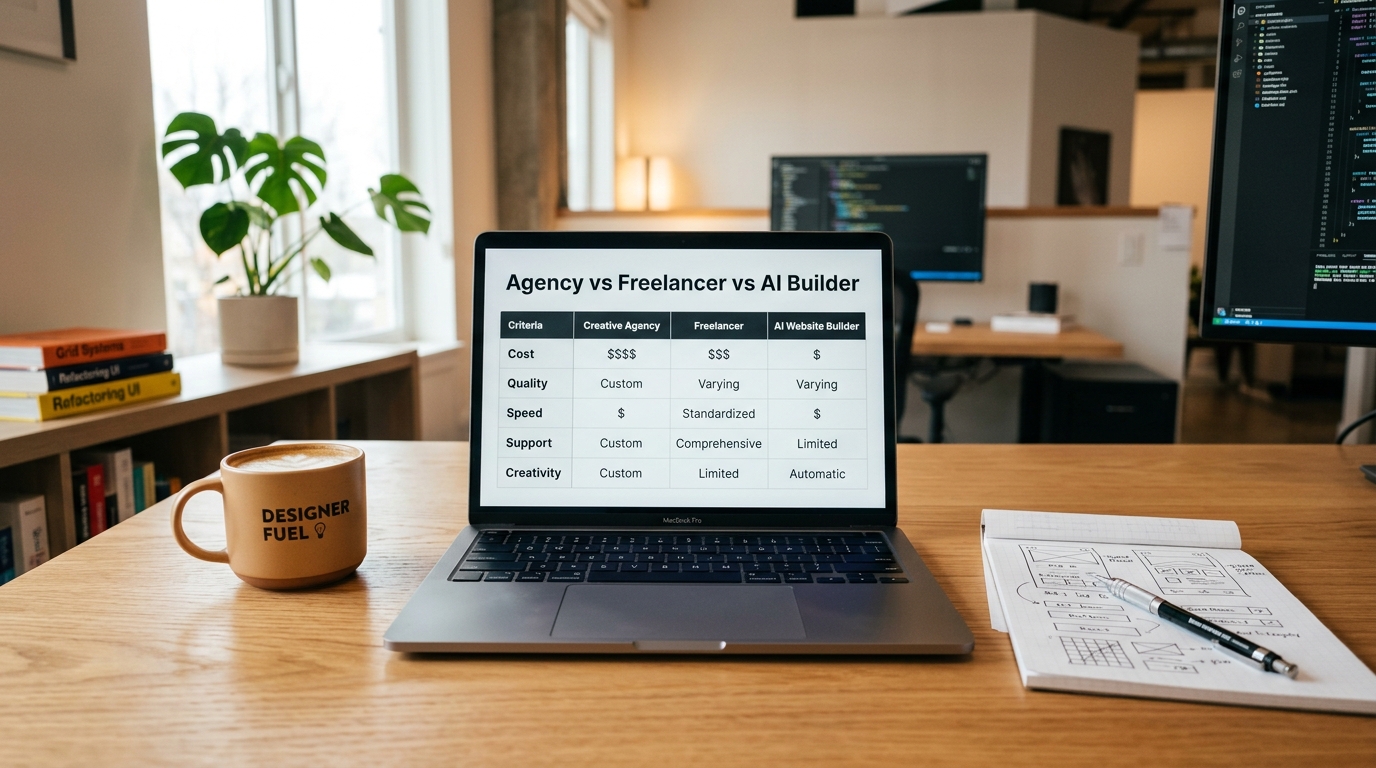
The Definitive Comparison: AI Builders vs Freelancers vs Specialized Agencies
Evaluation Dimension
AI Website Builders
Solo Freelancers
Specialized Digital Agency
Typical Cost
$20 - $80 / month (SaaS)
$1,500 - $8,000 (Project)
$8,000 - $50,000+ (Project)
Delivery Timeline
10 minutes - 2 days
2 - 6 weeks
4 - 10 weeks
Code & IP Ownership
Zero (Locked to platform)
Partial / Unclear
100% Sovereign (Full Git Repo)
Design Originality
Low (Template derivative)
Moderate (Template customization)
Exceptional (Bespoke Figma UI/UX)
Core Web Vitals (LCP)
1.8s - 3.5s (Average)
1.5s - 2.8s (Variable)
< 1.0s (Guaranteed 100/100)
Custom API Integrations
Extremely limited / Impossible
Moderate (Skill-dependent)
Unlimited (Enterprise grade)
Operational Risk
Platform deprecation / lock-in
High (Key-person abandonment)
Zero (SLA, contracts, redundancy)
The Strategic Decision Framework: Choosing Your Delivery Model
To make the optimal commercial decision, align your choice with your business revenue stage:
- Stage 1 (Pre-Revenue Validation, <$50k ARR): Use an AI builder or basic Squarespace site. Validate that people want what you sell before committing capital to engineering.
- Stage 2 (Early Traction, $50k - $300k ARR): Engage a capable freelance developer or boutique agency for modular, focused landing page improvements.
- Stage 3 (Scaling Enterprise, $300k+ ARR): Partner with a specialized digital engineering agency. At this scale, your website is your primary revenue engine, sales rep, and brand validation asset. The conversion uplift, SEO dominance, and reliability of custom engineering deliver compounding returns on investment.
Business Implications & ROI Analysis
Commercial Opportunities
•Partnering with a specialized agency unlocks bespoke workflows that competitors using template builders cannot replicate.
•Sovereign code ownership protects enterprise valuation during corporate acquisitions or fundraising rounds.
•100/100 Google Lighthouse scores lower Google Ads acquisition costs and elevate organic search rankings.
Risks & Limitations
•Over-investing in custom agency code before validating product-market fit burns critical early-stage runway.
•Selecting cheap overseas freelancers often results in unmaintainable spaghetti code that must be rewritten from scratch.
•Building on proprietary AI platforms leaves your business vulnerable to sudden monthly pricing spikes.
Recommended Next Steps for Business Leaders
Map your technical requirements: determine if you require custom database logic, payment rails, or standard brochure pages.
Audit your existing website against Google Core Web Vitals to quantify performance revenue leakage.
Demand full Git repository transfer and written IP assignment clauses in all developer agreements.
Need Expert Help with Website Design?
From custom Next.js engineering and AI automation to high-performance search optimization, Techsist Labs partners with ambitious businesses worldwide to build solutions that scale revenue.
The rise of autonomous buyer agents: how machine-to-machine commerce, programmatic product feeds, and headless checkout APIs are replacing traditional consumer browsing behavior.
A hands-on review of the native generative AI features in Xero (Just Ask Xero / JAX) and MYOB: bank feed reconciliation accuracy, automated GST coding, and where human bookkeepers remain essential.
A financial decision framework for business executives: calculating total cost of ownership (TCO), break-even timelines, and strategic risks between buying commercial SaaS versus building custom AI pipelines.