Evaluating an AI Vendor: 12 Questions to Ask Before Signing
A commercial due-diligence checklist for business executives: 12 critical technical, legal, and operational questions to ask software vendors selling AI solutions.
Conducting rigorous vendor due diligence protects your business from data leaks, hidden token markups, and abandoned proprietary software.
Executive Summary & Key Takeaways
Over 75% of new "AI software" startups are thin wrappers around commercial foundation models with massive unearned price markups.
Verifying data training terms is non-negotiable: your proprietary customer data must never be used to train public foundation models.
Vendors must provide transparent Service Level Agreements (SLAs) covering response latency and hallucination dispute policies.
Contractual exit rights and data portability guarantees prevent your company from being trapped on an unmaintained proprietary silo.
What to Do About This: Action Checklist
1Require every prospective AI software vendor to provide their standard Data Processing Agreement (DPA) before beginning pilot discussions.
2Demand an itemized breakdown of underlying API token usage versus vendor platform subscription fees.
3Test the vendor solution on 20 complex real-world edge cases rather than accepting their curated sales demo.
4Partner with our independent technology advisors at /services/ai-automation/ to conduct an objective procurement review.
The Wrapper Epidemic: Separating True Innovation from Hype
Every business executive is currently inundated with sales pitches from software vendors promising to revolutionize their business with AI. However, venture capital data reveals that an estimated 75% of these solutions are "thin wrappers": software that does little more than take your prompt, forward it to OpenAI or Anthropic with a 500% price markup, and display the result in a basic UI.
When that underlying LLM updates its interface or releases an identical native feature, these wrapper companies collapse overnight, leaving their business customers stranded. Before signing a multi-year software agreement, procurement teams must execute rigorous due diligence.
Category 1: Data Privacy, Training, and IP Ownership
Question 1: Do you, or any of your upstream subprocessors, use our company data, prompts, or customer interactions to train your AI models?
- Expected Answer: An unqualified "No". The vendor must show an explicit clause in their Data Processing Agreement (DPA) guaranteeing zero-retention or zero-training.
Question 2: In which geographic jurisdictions is our data processed and stored?
- Crucial for Australian and European businesses subject to the Privacy Act 1988 or GDPR. Data containing Australian citizen health or financial records must meet strict data residency requirements.
Question 3: Who owns the intellectual property of the generated outputs, code, and synthesized databases?
- Contract terms must explicitly state that the client retains 100% full legal title to all inputs, outputs, and derivative analytical models.
Question 4: How is data isolated between different tenant accounts?
- The vendor must prove logical or physical tenant isolation (such as vector database namespace partitioning) to guarantee your data cannot bleed into a competitor inquiry.
Category 2: Architecture, Reliability, and Hallucinations
Question 5: Which specific underlying foundation models power your platform, and what is your multi-model redundancy strategy?
- If the vendor relies entirely on a single model endpoint without fallback logic, an outage at OpenAI takes your entire commercial operation offline.
Question 6: How do you measure and benchmark hallucination rates for our specific industry domain?
- Demand concrete evaluation metrics (such as Ragas or TruLens scores) on industry-specific datasets, not generic marketing claims of "99% accuracy".
Question 7: What programmatic guardrails and human-in-the-loop controls exist to prevent unauthorized actions?
- Does the system allow automated financial transactions or refunds without human sign-off?
Question 8: What are your guaranteed response latency and uptime Service Level Agreements (SLAs)?
- An AI receptionist or customer chat tool with an average response time of 8 seconds will destroy your customer conversion rate.
Category 3: Commercial Terms, Costs, and Exit Strategy
Question 9: What is the exact pricing model: seat-based, flat monthly, or variable token/usage consumption?
- Beware of hybrid models where you pay $500/month plus unpredictable per-token overages that balloon during busy holiday seasons.
Question 10: Can we export our complete raw data, vector embeddings, and prompt configurations in an open format if we cancel?
- If the vendor locks your knowledge base in a proprietary encrypted format that cannot be exported to standard JSON or CSV, you are effectively trapped.
Question 11: Does your software adhere to open protocol standards like the Model Context Protocol (MCP)?
- Open protocols ensure your integrations remain compatible with future AI tooling.
Question 12: What is your financial runway, and what happens to our data and software access if your company is acquired or shuts down?
The Commercial Procurement Scorecard
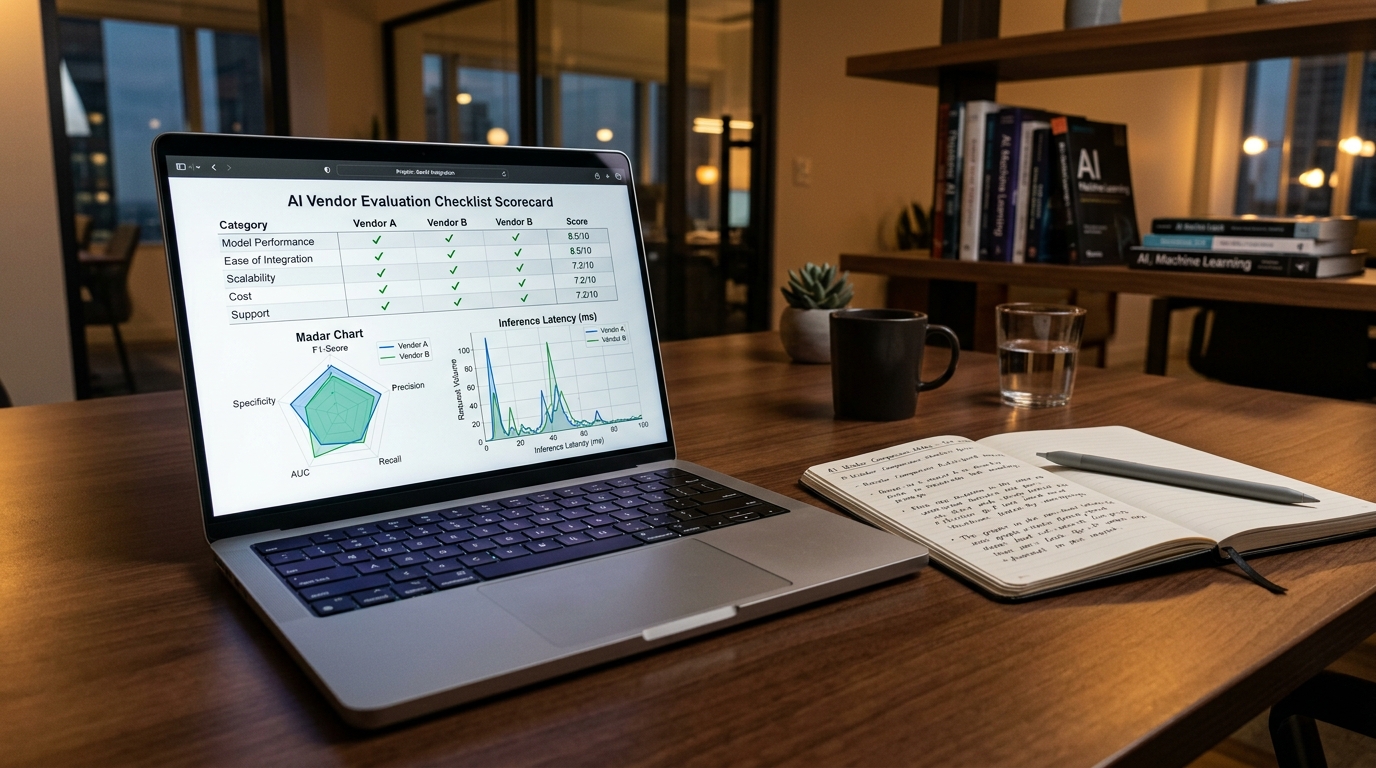
Assign a simple 1 to 5 score across each of the 12 questions. Any vendor that scores less than 45 out of 60, or fails to provide an unambiguous answer on Data Training Terms (Question 1) or Data Portability (Question 10), should be disqualified from enterprise consideration.
Business Implications & ROI Analysis
Commercial Opportunities
•Protecting company balance sheets from predatory multi-year contracts for commoditized wrapper software.
•Selecting robust enterprise AI partners with genuine architectural depth and legal data safeguards.
Risks & Limitations
•Signing contracts with vendors that quietly monetize your proprietary customer data to train public foundation models.
•Experiencing catastrophic vendor lock-in where mission-critical business knowledge cannot be exported.
Recommended Next Steps for Business Leaders
Distribute this 12-question scorecard to your company IT procurement and executive evaluation committees.
Refuse to sign any enterprise AI agreement that lacks an explicit zero-model-training clause in the DPA.
Need Expert Help with Ai Automation?
From custom Next.js engineering and AI automation to high-performance search optimization, Techsist Labs partners with ambitious businesses worldwide to build solutions that scale revenue.
The rise of autonomous buyer agents: how machine-to-machine commerce, programmatic product feeds, and headless checkout APIs are replacing traditional consumer browsing behavior.
A hands-on review of the native generative AI features in Xero (Just Ask Xero / JAX) and MYOB: bank feed reconciliation accuracy, automated GST coding, and where human bookkeepers remain essential.
A financial decision framework for business executives: calculating total cost of ownership (TCO), break-even timelines, and strategic risks between buying commercial SaaS versus building custom AI pipelines.